
Comprehensive Accessibility for Every Spectrum of Color Vision
Introduction
Over 300 million people worldwide experience some form of color vision deficiency, yet 79% of websites still feature low-contrast text that makes navigation nearly impossible for these users. Today, we're excited to announce the launch of our Color Blindness Profiles feature—a comprehensive solution that empowers users with any type of color vision deficiency to experience your website as intended. With just one click from our AI-powered widget, users can select from eight specialized profiles designed to accommodate every spectrum of color blindness.
The Challenge of Digital Accessibility for Color-Blind Users
Color blindness affects approximately 1 in 12 men and 1 in 200 women globally—roughly 4.5% of the population. For these users, standard web design practices create significant barriers to accessing digital content. Research shows that color-blind users are 30% more likely to click on monochrome images because color-dependent design elements fail to guide them effectively.
Many businesses unknowingly exclude millions of potential customers by relying solely on color to convey critical information like error messages, form validations, or call-to-action buttons. With the European Accessibility Act (EAA) now in force as of June 2025, this isn't just an accessibility concern—it's a legal requirement.
Understanding the European Accessibility Act Requirements
The EAA sets EU-wide accessibility requirements for e-commerce, banking, transportation, and digital services across all 27 Member States. To comply with the EAA, businesses must meet accessibility requirements aligned with EN 301 549, which incorporates WCAG 2.1 Level AA criteria as its foundation.
These requirements mandate that digital experiences must be perceivable, operable, understandable, and robust (POUR) for users with disabilities. For color accessibility specifically, this means:
- Color cannot be the only method used to convey information (WCAG Success Criterion 1.4.1)
- Minimum contrast ratios of 4.5:1 for normal text and 3:1 for large text (WCAG Success Criterion 1.4.3)
- UI components and graphics require at least 3:1 contrast ratio
While June 2025 marked the enforcement deadline for newly published digital content, all existing digital content must achieve full compliance by June 2030. Early 2026 has seen regulators establish accountability frameworks, with enforcement focusing on whether organizations take reasonable steps to address accessibility issues.
Understanding Color Vision Deficiencies
Color vision deficiency occurs when the eye's cone cells fail to perceive colors accurately. The condition manifests in several distinct types, each affecting how individuals perceive the color spectrum:
Red-Green Color Blindness
The most common form, accounting for 98% of all color blindness cases:
- Protanopia: Absence of red cones, causing difficulty distinguishing reds from greens
- Protanomaly: Reduced sensitivity to red light, making reds appear more green
- Deuteranopia: Absence of green cones, making greens appear more red
- Deuteranomaly: Reduced sensitivity to green light—the most common form overall
Blue-Yellow Color Blindness
Less common but equally impactful:
- Tritanopia: Absence of blue cones, causing difficulty distinguishing blues, greens, purples, reds, and yellows
- Tritanomaly: Reduced sensitivity to blue light, affecting perception of blue and yellow hues
Complete Color Blindness
The rarest forms:
- Achromatopsia: Complete absence of color vision, seeing only in shades of grey
- Achromatomaly: Severely limited color perception
How Our Color Blindness Profiles Work
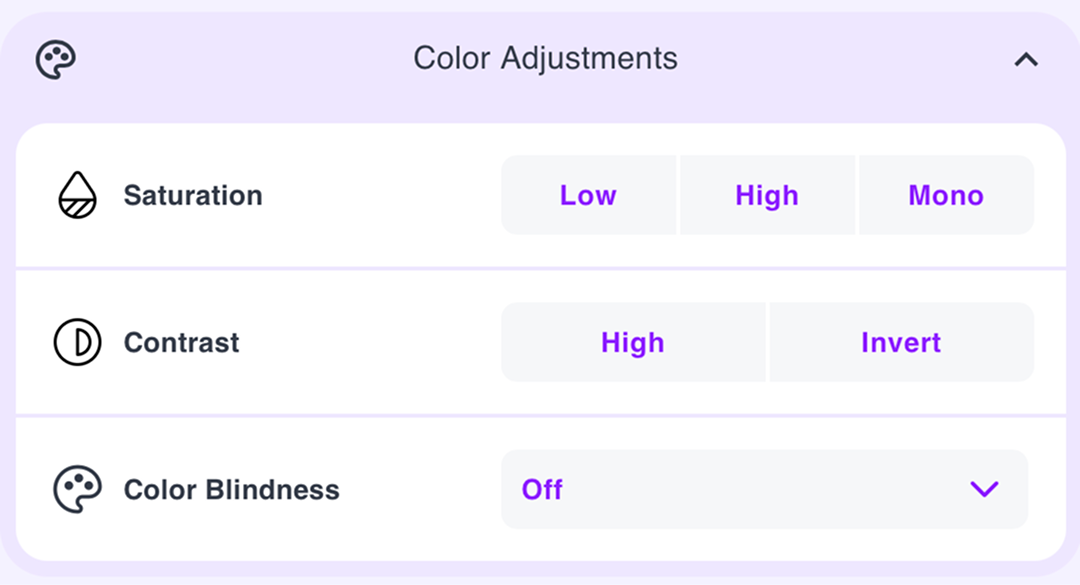
Our AI-powered accessibility widget now includes dedicated profiles for all eight types of color vision deficiency. We've designed this feature with simplicity in mind—users simply:
- Click the Wawsome accessibility icon on your website
- Select "Color Blindness" from the widget menu
- Choose their specific vision type from the eight available profiles
- Experience your website with optimized color adjustments instantly

Each profile applies specialized color filters that transform your website's color scheme to match how users with that specific type of color blindness perceive colors. This ensures that all visual information, contrast ratios, and design elements remain distinguishable and accessible.
Meeting EN 301 549 and WCAG Requirements
EN 301 549 serves as the presumptive standard of conformity for EAA compliance. This harmonized European standard incorporates WCAG 2.1 Level AA in its entirety while expanding its scope to include hardware, telecommunications, and other ICT components.
Our Color Blindness Profiles help businesses meet these compliance requirements by ensuring that users with color vision deficiencies can perceive all visual information effectively. This directly addresses WCAG Success Criterion 1.4.1 (Use of Color) and supports overall conformance with the functional accessibility requirements mandated by the EAA.
The EAA requires businesses to publish accessibility statements that describe their products' accessibility features and ongoing efforts to maintain accessibility. Our widget enables you to demonstrate concrete steps toward meeting these requirements while providing an inclusive user experience for all visitors.
Implementation Strategies for EAA Compliance
Automated Accessibility Scanning
Integrate our widget on your website to provide users with instant access to color blindness profiles. The widget automatically detects and flags potential accessibility issues before they impact users or trigger regulatory attention.
Design Beyond Color Alone
While our profiles optimize color perception, combine them with best practices like using icons, text labels, patterns, and textures alongside color-coded information. The EAA emphasizes a "design for all" approach that ensures products and services are usable by everyone without requiring specialized design.
Continuous Monitoring
Website updates and redesigns can introduce new accessibility barriers. The regulatory landscape in 2026 increasingly focuses on accountability over time—whether accessibility is being monitored and whether recurring issues are addressed. Regular audits ensure your site remains compliant as content evolves.
Create Accessibility Statements
Develop accessibility statements that align with EAA requirements, including descriptions of your accessibility features, conformance status with EN 301 549, and contact information for user feedback.
Common Mistakes to Avoid
- Assuming templates are accessible: Pre-built themes rarely include comprehensive color blindness accommodations
- Ignoring contrast in all states: Ensure adequate contrast for hover states, disabled buttons, error messages, and focus indicators
- Color-only form validation: Red/green indicators for errors must include text descriptions or icons
- Overlooking charts and graphs: Data visualizations that rely solely on color differences become meaningless to color-blind users
- Treating compliance as one-time: EAA compliance requires ongoing responsibility, not a static state
Real-World Impact
Approximately 75% of color-blind individuals report needing coworkers to verify colors for them weekly or daily, with 31% requiring assistance almost daily. By implementing our Color Blindness Profiles, businesses can eliminate this dependency and provide autonomous, dignified access to digital content.
Among people with dichromatic vision (complete absence of one cone type), 86% report difficulties with color-related everyday tasks. Our specialized profiles directly address these challenges by transforming color schemes to match each user's unique perception.
The Future of Inclusive Design in Europe
As the EAA enforcement phase progresses through 2026, regulatory authorities are establishing accountability frameworks that focus on whether organizations demonstrate reasonable efforts to address accessibility. This pattern mirrors early GDPR enforcement, where the first year focused on guidance and observation before consequences followed.
Individual Member States have transposed the EAA into their national laws with unique nuances—France requires annual accessibility action plans, Spain allows substantial penalties, and Ireland may impose jail time for violations. Businesses operating across the EU should track local legislation to ensure full compliance in different countries.
Our Color Blindness Profiles represent our commitment to making the web accessible for everyone, regardless of how they perceive color. This feature joins our comprehensive suite of accessibility tools designed to help businesses achieve EN 301 549 conformance while improving user experience for all visitors.
Getting Started with Color Blindness Accessibility
Making your website accessible to color-blind users is easier than ever with our AI-powered widget. The Color Blindness Profiles feature is now available to all our users, providing instant accessibility improvements without requiring any code changes or design modifications to your existing website.
Start by scanning your website and discover your current accessibility gaps and see where color-related issues may be affecting your users.
Want to see our Color Blindness Profiles in action? Schedule a demo to experience how our widget can transform your website's accessibility and ensure EAA compliance.
Visit our Accessibility Resources hub to learn more about our complete range of features designed for inclusive digital experiences.
FAQs
Q: What types of color blindness does the widget support?
A: We support all eight major types: Protanopia, Protanomaly, Deuteranopia, Deuteranomaly, Tritanopia, Tritanomaly, Achromatopsia, and Achromatomaly.
Q: Do I need to modify my website's code to use the Color Blindness Profiles?
A: No code changes are required. Once our widget is installed, users can access all color blindness profiles instantly through the widget interface.
Q: How does this feature help with EAA compliance?
A: The Color Blindness Profiles help meet WCAG 2.1 Success Criterion 1.4.1 (Use of Color), which is incorporated into EN 301 549—the presumptive standard for EAA compliance. This ensures users with color vision deficiencies can perceive all visual information effectively.
Q: What percentage of website visitors might need color blindness accommodations?
A: Approximately 4.5% of the global population has some form of color vision deficiency—that's over 300 million people worldwide.
Q: How can I check if my website has color accessibility issues?
A: Visit scan.wawsome.com to run a free accessibility scan that identifies color contrast issues and other accessibility barriers on your website.