
Make digital learning and student services work for more people
Digital accessibility for education
Wawsome helps schools, universities, academies and online learning providers find, prioritize, fix and continuously monitor accessibility barriers across admissions, student portals, LMS courses, assessments, learning content and administrative services.
- Checks for admissions, portals, LMS and assessments
- Documents, video and vendor tools flagged for their own plan
23.9%
of people aged 16 and over in the EU have a disability.
Source: Eurostat, 2024
24.6%
of young people aged 18 to 24 with a disability in the EU left education and training early, compared with 8.0% of those without a disability.
Source: Eurostat, Disability statistics: access to education and training, 2024 data
57%
of public sector websites assessed in the EU failed at least one of eight selected WCAG criteria.
Source: European Commission, eGovernment Benchmark 2025, 2024 data
Digital education only works when learners can actually use it.
Schools and universities run discovery, admissions, enrollment, learning, assessment and student services online. When these channels aren't accessible, it affects participation, results, workload and your institution's reputation.
Program discovery
Where learners get stuck
Course catalogs with vague links, filters a keyboard can't use and key dates shown only in images.
How Wawsome helps
The scanner flags link text, filter controls and missing text alternatives by severity, so prospective learners can find the right program.
Application and enrollment
Where learners get stuck
Long application forms, document uploads that only work with a mouse and errors with no hint on how to fix them.
How Wawsome helps
Labels, instructions, errors and upload controls are listed in plain language and prioritized, so more applicants can finish on their own.
Sign-in and student portal
Where learners get stuck
Login steps that time out, dashboards with unlabeled icons and menus a screen reader can't follow.
How Wawsome helps
Focus order, names of controls and timeouts are checked first, because nothing else works if students can't get in.
Course navigation and LMS
Where learners get stuck
Course pages built differently by every teacher, modules that open only on hover and LMS components from a vendor.
How Wawsome helps
Monitoring gives every faculty the same baseline. Issues inside vendor LMS components are reported separately for escalation.
Learning content and video
Where learners get stuck
Recorded lectures without captions, slides only in PDF and images with no description.
How Wawsome helps
Missing image descriptions are flagged, and AI suggests texts you can review. Videos and documents go into their own plan, because they need work at the source.
Assessment
Where learners get stuck
Online tests with time limits that can't be adjusted, drag-and-drop questions and results shown only by color.
How Wawsome helps
Assessment pages get specific attention. Issues in external test or proctoring tools are reported separately for the vendor.
Support, certificates and admin
Where learners get stuck
Help forms, certificate requests and admin services that only work with a mouse, or only as a PDF to print.
How Wawsome helps
Admin forms and help pages are checked on every scan, so students can do routine tasks without calling or visiting an office.
Which accessibility rules apply to education websites?
It depends on who runs the service. Public universities and public education bodies fall under the Web Accessibility Directive and national law. EU countries may exclude school websites, except essential online admin services. For private providers and online learning platforms, the European Accessibility Act can apply when courses are sold online to consumers.
| Provider | Main rules | What it means for your website |
|---|---|---|
| Public universities and education bodies | Web Accessibility Directive and national law | Websites and apps should meet WCAG 2.1 AA, publish an accessibility statement and offer a way to report barriers. |
| Schools, kindergartens and nurseries | Web Accessibility Directive (countries may exclude them, except essential admin services) | Depends on the country. Content for essential online admin services stays in scope. |
| Private providers and online learning platforms | European Accessibility Act, e-commerce services (can apply) | Selling courses online to consumers can be in scope since 28 June 2025. Check with your legal team. |
| Every education provider | WCAG 2.1 AA and EN 301 549 | The technical standard the laws point to, and a practical baseline for learner journeys. |
Sources: Directive (EU) 2016/2102, Article 1(3), and Directive (EU) 2019/882, Article 2(2)(f). Rules for schools differ by country. This is general information, not legal advice.
Protect the whole learner journey, not just individual pages.
Eight risks for schools, universities and learning providers, each with how Wawsome responds and the KPI it touches.
Compliance and governance
Public education bodies may need an accessibility statement, a feedback process and monitoring. For private providers, the rules depend on the service, the owner and national law.
How Wawsome helps
Findings can be organized around your obligations, the Accessibility Statement, feedback and recurring monitoring, with a documented fix history.
- Accessibility complaints
Access to education
Inaccessible admissions pages, catalogs, LMS screens, timetables or forms can stop learners from studying or using services on their own. Students with disabilities feel this the most.
How Wawsome helps
Admissions, portals, course navigation, assessments and admin forms are checked first, where the impact on learners is highest.
- Portal task completion
Enrollment and conversion
For private universities, academies and online platforms, barriers in discovery, application, sign-up or payment can turn interested learners into abandoned applications.
How Wawsome helps
Application, account creation, registration and payment are treated as conversion-critical steps and prioritized in the fix plan.
- Enrollment conversion
Retention and completion
Repeated friction in lessons, assignments, assessments and dashboards adds effort and support needs, and can contribute to avoidable dropout or delays.
How Wawsome helps
Course navigation, dashboards and assessments are prioritized, so learners can do more on their own. Wawsome doesn't promise academic results.
- Course completion
Workload and digital ROI
When learners can't finish a task online, they turn to admissions, faculty, disability services or IT. Portals and LMS platforms then deliver less of the value you invested in.
How Wawsome helps
Reports show where self-service breaks, so your teams can fix the steps that create the most requests first.
- Assisted-channel volume
Documents and multimedia
PDFs, slides, syllabi, forms and recorded lectures can stay inaccessible even after the website improves.
How Wawsome helps
Documents and media are listed as their own work stream, so they don't get lost in the website backlog.
- Course participation
Third-party tools
LMS platforms, video tools, assessment and proctoring systems, sign-in services and library platforms can break the journey even when your own site is accessible.
How Wawsome helps
Issues that come from vendor tools are reported separately, ready for vendor escalation, contract talks or your next tender.
- Assessment completion
Many publishers, frequent changes
Faculties, teachers and admin teams publish across thousands of pages. LMS updates, new templates and plugins can bring issues back after a fix.
How Wawsome helps
Recurring scans give every site and faculty one baseline and alert you when a change brings new issues.
- Accessibility complaints
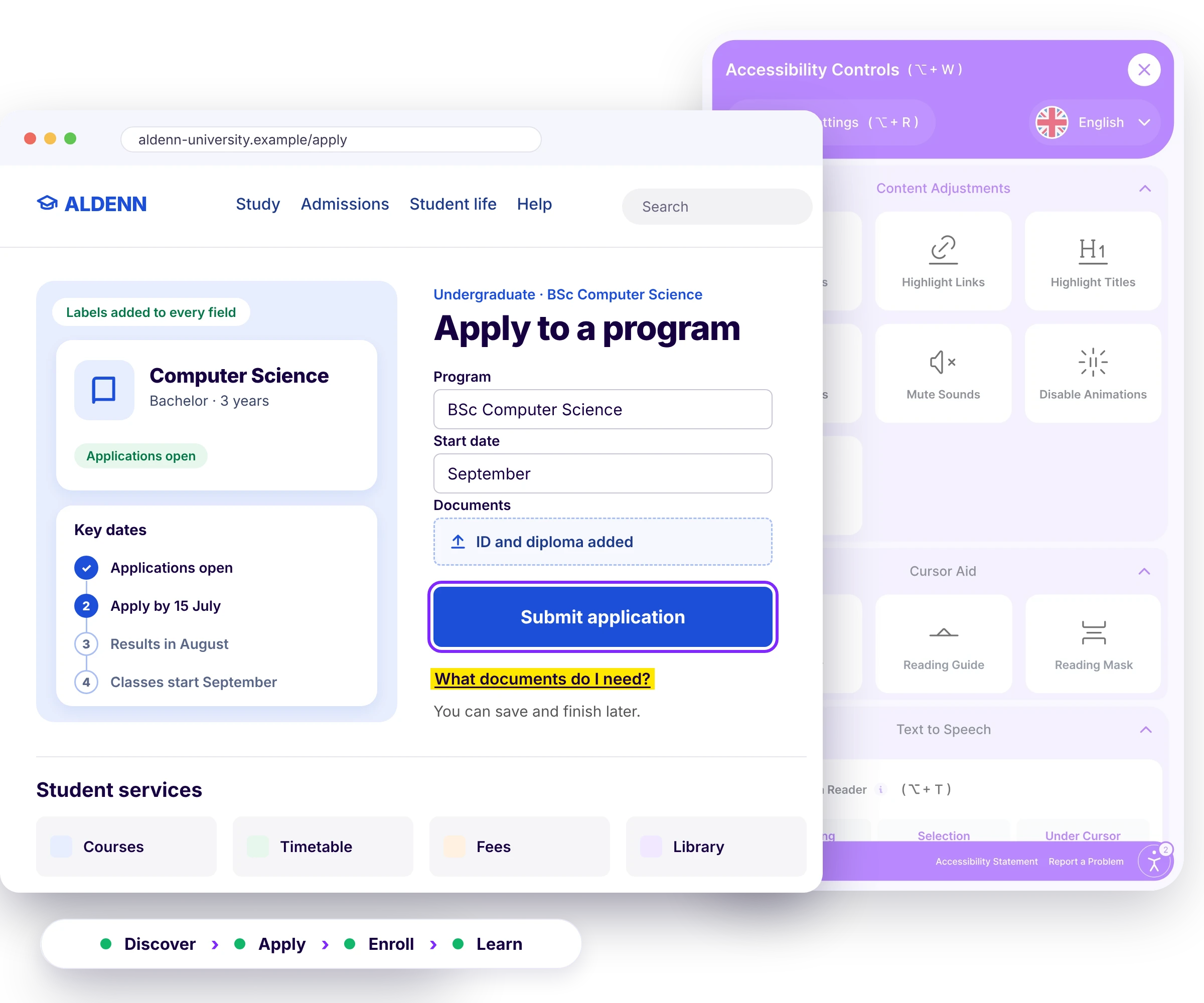
See the difference on an application form
Turn on a few widget settings and watch this sample form change. It's a small preview of what the Wawsome widget does on your site.
Try it on this form
Apply to a program
Program: BSc Computer Science. Start: September. Documents: ID, diploma.
You can save your application and finish it later.
What documents do I need?Submit application
One platform. Every angle covered.
Automatic fixes
AI scans and patches selected issues such as missing image descriptions, broken ARIA and navigation structure.
Ongoing tracking
Your site is checked continuously, with accessibility score, issue trends and full history available in one place.
Easy setup
Deploy through one JS line or a GTM tag. Wawsome works at the browser layer, without server-side codebase changes.
Accessibility Statement
An individual Accessibility Statement, mapped in Wawsome documentation to the EAA, WCAG 2.1 AA, EN 301 549 and national laws.
Accessibility Widget
Predefined accessibility profiles, controls for text size, spacing, typeface, contrast and color scheme, keyboard-only navigation, screen-reader support, AI-assisted ALT and ARIA improvements, brand configuration and multi-language support.
Accessibility Scanner
WCAG 2.1 and 2.2 AA checks, prioritized plain-language reporting, Low, Medium and High severity, visibility across WCAG A, AA and AAA and an overall risk score.
- WCAG 2.1 and 2.2 AA
- EN 301 549
- European Accessibility Act


Continuous monitoring
Recurring scans check changes, alerts highlight areas that need attention and reports provide step-by-step remediation guidance.
A change goes live
A new course, an LMS update, a new template or a content change.
A recurring scan checks it
Wawsome scans your pages again on schedule.
An alert flags what changed
New issues are highlighted by severity.
The right team fixes it
Reports give step-by-step guidance.
LMS, video, assessment and library tools need their own plan
Many learning journeys run through external LMS platforms, video tools, assessment systems or library services. Wawsome works on your website and on vendor pages that allow the script. What it can't change in the browser goes to the vendor, your next tender or your technical backlog.
Needs the vendor or the source
- LMS and student portals run by a vendor, if the script can't be added there
- Payment pages hosted by a payment provider
- Video players, assessment and proctoring tools embedded from other providers
- Syllabi, slides, forms and course materials in PDF
- Free or self-hosted widgets often need your own server or API, plus security updates you maintain
- No clear answer on where visitor data is processed, or a data processing agreement
What Wawsome does
- Runs on your website and on portal and LMS pages that allow the script
- Monitors many faculties, schools and sites from one place
- Reports third-party issues separately, for technical or contractual escalation
- Moves issues it can't fix in the browser into a prioritized technical backlog
- Hosted and updated by Wawsome, with no server or API to run on your side
- ISO 27001 certified information security and GDPR-aligned data processing
Accessibility that supports learning, student services and the KPIs your institution already manages.
Broader access
More learners can find, use and complete educational and admin services on their own.
- Digital service completion
- Portal task completion
Enrollment potential
Fewer barriers in discovery, application, registration and payment help protect your recruitment work.
- Application completion
- Enrollment conversion
More learner autonomy
Clearer navigation and sturdier interactions let students do more without asking for help.
- Portal task completion
- Assisted-channel volume
Lower admin workload
Fewer accessibility blockers can mean fewer calls, emails and visits for tasks built to be digital.
- Cost-to-serve per student
Participation and completion
Removing repeated friction supports engagement in courses and assessments. Measure the effect on your own learner data.
- Course participation
- Assessment completion
Governance at scale
Leadership gets structured evidence of status, fixes and monitoring across faculties, instead of isolated audits.
- Issue trend
- Progress history
Measure what accessibility changes
Accessibility work is easier to defend when you can see it in numbers. Wawsome tracks the accessibility side on every scan. Your teams can then follow the business KPIs that barriers affect most, journey by journey.
What Wawsome measures for you
Tracked on every scan, in one dashboard.
- Accessibility score and overall risk score
- Issues by severity: low, medium and high
- New issues after releases and content changes
- Issue trend and progress history over time
- Third-party issues, reported separately
Business KPIs accessibility can influence
KPIs that schools, universities and learning providers already track. Watch them next to your accessibility data.
Recruitment and enrollment
- Application completion
- Enrollment conversion
Learning and progression
- Course completion
- Assessment completion
Service and cost
- Assisted-channel volume
- Cost-to-serve per student
These are KPIs to watch, not promised results. The impact depends on your site, your journeys and how fast issues get fixed.
Trusted by Leaders and Industry Innovators


See where accessibility barriers may be affecting learning and student services.
Start with your own digital estate. Find barriers across admissions, student portals, LMS courses, assessments and admin services. Then build a prioritized plan to fix and monitor them.
Need a manual audit of your website and documents? See our audits
Accessibility is becoming part of how organizations measure digital inclusion and service quality.
The Valuable 500 includes digital accessibility among five proposed disability inclusion KPIs. It asks whether organizations review the accessibility of their digital platforms and content, and whether they have a plan to do so. Yet the research it cites shows most websites are still not fully accessible.
16%
of the world's population experience significant disability
Upwards of 90%
of the world's websites are not fully accessible to the disability community
Source: The Valuable 500
Education opens doors. Accessibility decides whether every learner can walk through them online.
Education digital accessibility FAQ
What is digital accessibility in education?
It means making websites, learning platforms, digital content and student services usable for people with visual, hearing, motor, cognitive or learning needs. It covers the whole journey, from admissions and enrollment to learning, assessment and admin.
Why is digital accessibility important for schools and universities?
Education providers rely on digital channels for admissions, learning and student services. Barriers can stop learners from working on their own, add support requests, affect participation and create governance or reputation risks.
Which education journeys should be prioritized?
Start with program discovery, admissions, enrollment, sign-in, student portals, course navigation, assessments, payments where relevant, certificates, support and admin forms.
Do accessibility laws apply to schools and universities?
Often, but not in the same way. Public universities and education bodies fall under the Web Accessibility Directive and national law. EU countries may exclude school websites, except essential online admin services. Private providers depend on the service: the EAA can apply when courses are sold online to consumers. Check with your legal team.
How can accessibility affect enrollment?
For private universities, academies and online platforms, barriers in course discovery, application, sign-up, registration or payment can lead to abandoned applications. Measure the real effect on your own funnel data.
How can accessibility influence course completion?
Repeated friction in lessons, assignments, assessments or dashboards adds effort and support needs. Removing avoidable barriers can support participation and completion. Wawsome doesn't promise academic results, so measure against your own learner data.
Why does an LMS need accessibility monitoring?
LMS platforms change through releases, new courses, plugins, templates and content. A one-time audit gets outdated fast, while recurring monitoring finds issues after each change.
What does the Wawsome Accessibility Widget do?
The Widget provides accessibility profiles and controls for text size, spacing, typography, contrast and color, along with keyboard-only navigation, screen-reader support and AI-assisted improvements for selected ALT, ARIA and structural issues.
What does the Wawsome Scanner do?
The Wawsome Scanner supports WCAG 2.1 and 2.2 AA checks, severity-based prioritization, risk scoring, recurring monitoring, alerts and reporting, so teams can see which issues need attention.
What accessibility risks exist in PDFs and learning materials?
PDFs, slides, syllabi, course notes, policies and forms can stay inaccessible even after the website improves. They usually need their own inventory, priorities and fixes at the source.
How should universities manage accessibility across many faculties and sites?
Central monitoring gives every faculty, school, domain and content owner the same baseline. Leadership sees recurring issues, sets priorities and reduces the gaps that come from decentralized publishing.
How should institutions manage third-party accessibility risks?
Issues in LMS components, video players, assessment tools, sign-in services or other external systems should be isolated and documented. Then you can raise them with the vendor, cover them in contracts or add them to your technical plan.
Does Wawsome require a complete website rebuild?
No. Wawsome deploys through a JavaScript tag or Google Tag Manager and works at the browser layer, without server-side codebase changes. Structural issues and third-party components that need source-level work are identified and prioritized separately.
Make accessibility part of how your institution delivers learning and digital services.
You already track enrollment, participation, completion, student satisfaction, support demand and digital adoption. Add accessibility to the same measurement and find the barriers that stop learners from finishing key steps on their own.
- Accessibility Widget
- Scanner
- Continuous Monitoring
- Accessibility Statement
- Third-party issue reports
- Multi-language support