
Help more people reach, read and watch your content
Digital accessibility for media
Wawsome helps publishers, broadcasters and digital media providers find, prioritize, fix and continuously monitor accessibility barriers across articles, navigation, search, video, login, paywalls, subscriptions and payment.
- Checks for articles, video, login and paywalls
- Player, subtitle and payment tools flagged for their own plan
23.9%
of people aged 16 and over in the EU have a disability.
Source: Eurostat, 2024
66%
of people in the EU aged 16 to 74 read news online in 2025, up from 47% in 2013.
Source: Eurostat, ICT usage in households and by individuals, 2025
48%
of people in the EU aged 16 to 74 watched streamed TV from broadcasters in 2024. Half watched video on demand.
Source: Eurostat, ICT usage in households and by individuals, 2024
Content only creates value if people can find it, navigate it and consume it.
Media businesses depend on reach, attention, repeat visits and subscriptions. Barriers can shrink the audience that discovers your content, moves through the site, plays your video or finishes a subscription. And with dozens of new stories a day, the same barriers can come back every day.
Discover and search
Where readers get stuck
Search fields without labels, results a screen reader can't follow and filters that only work with a mouse.
How Wawsome helps
The scanner flags search, filter and result issues by severity, so readers can reach the story they came for.
Homepage and sections
Where readers get stuck
Crowded homepages, menus that open only on hover and teasers with vague links like “read more”.
How Wawsome helps
Navigation, focus order and link text are checked on your main templates, so one fix reaches every section page.
Article
Where readers get stuck
Skipped heading levels, images with no description, low contrast and embeds that trap the keyboard.
How Wawsome helps
Headings, image descriptions and contrast are listed in plain language. AI suggests image descriptions your editors can review.
Video and audio
Where readers get stuck
Players with unlabeled buttons, autoplay that can't be paused and clips without subtitles.
How Wawsome helps
Player controls on your pages are part of the scan. Subtitles and audio description go into their own plan, because they need work at the source.
Login and registration
Where readers get stuck
Sign-up forms without labels, CAPTCHAs with no alternative and errors that only show in red.
How Wawsome helps
Labels, errors and focus are checked first, because readers can't subscribe if they can't create an account.
Paywall and payment
Where readers get stuck
Paywall overlays that hide the page from screen readers, plan cards that only work with a mouse and payment fields from another provider.
How Wawsome helps
The paywall and plan selection get specific attention. Issues on hosted payment pages are reported separately for the provider.
Return and retention
Where readers get stuck
Newsletter sign-ups, saved articles and account settings that only work with a mouse.
How Wawsome helps
Account and newsletter pages are checked on every scan, so subscribers can manage everything on their own.
Which accessibility rules apply to media websites?
It depends on the service. The European Accessibility Act covers services that give access to audiovisual media, such as streaming sites, apps and players. News publishers aren't named, but selling subscriptions online to consumers can fall under its e-commerce rules. Public service broadcasters are excluded from the Web Accessibility Directive, but national law can still apply.
| Type of service | Main rules | What it means for your website |
|---|---|---|
| Broadcasters and streaming services | European Accessibility Act, services providing access to audiovisual media (can apply) | Websites, apps and players used to find and watch content can be in scope since 28 June 2025. Check with your legal team. |
| Publishers selling subscriptions online | European Accessibility Act, e-commerce services (can apply) | Selling subscriptions or e-books online to consumers can be in scope. Microenterprises are exempt. |
| Public service broadcasters | National law (excluded from the Web Accessibility Directive) | Depends on the country. The European Accessibility Act can still apply to their streaming services. |
| Every media website | WCAG 2.1 AA and EN 301 549 | The technical standard the laws point to, and a practical baseline for reader journeys. |
Sources: Directive (EU) 2019/882, Article 2(2)(b), (e) and (f), and Directive (EU) 2016/2102, Article 1(4). Subtitles and audio description fall under the Audiovisual Media Services Directive. This is general information, not legal advice.
Protect the whole reader journey, not just the article page.
Eight risks for publishers and media providers, each with how Wawsome responds and the KPI it touches.
Compliance
Media services can have accessibility duties under EU and national law. Streaming services and online subscriptions can be in scope, but the exact duties depend on the service and the country.
How Wawsome helps
Findings can be organized around your obligations, the Accessibility Statement and recurring monitoring, with a documented fix history.
- Critical issues
Reach and engagement
Barriers in navigation, search, articles, players, login or paywalls can stop part of your audience before they finish reading or watching.
How Wawsome helps
Homepage, section, search, article and video templates are checked first, where one fix reaches the most readers.
- Pages per session
SEO and discoverability
Weak headings, missing image descriptions and poor markup are accessibility barriers. They also make your content harder for search engines to read.
How Wawsome helps
Headings, text alternatives and labels are fixed where it matters most. Wawsome doesn't promise rankings.
- Organic traffic
Reputation
A publisher that covers equality and inclusion loses credibility if its own site is hard to use for people with disabilities.
How Wawsome helps
An Accessibility Statement and visible progress show readers that your product matches your editorial values.
- Return visits
Subscription revenue
Barriers in registration, login, the paywall or payment can stop an engaged reader from becoming a paying subscriber.
How Wawsome helps
Login, paywall, registration and payment are treated as commercial steps and prioritized in the fix plan.
- Subscription conversion
Advertising yield
A hard reading or viewing experience can mean less time on site and fewer pages read. That can put pressure on ad inventory.
How Wawsome helps
Reports show where readers get stuck, so teams can fix the templates that carry the most traffic first.
- Engagement
Publishing speed
Dozens of articles, images, embeds and videos a day can bring new issues back, even after a first round of fixes.
How Wawsome helps
Recurring scans check new content and template changes, and alert you when a release or story brings new issues.
- Recurring issue rate
Archive
Older articles, media files and legacy templates can stay inaccessible even after your current templates improve.
How Wawsome helps
Archive pages are prioritized by traffic, value and risk, instead of trying to fix years of content at once.
- Monitored coverage
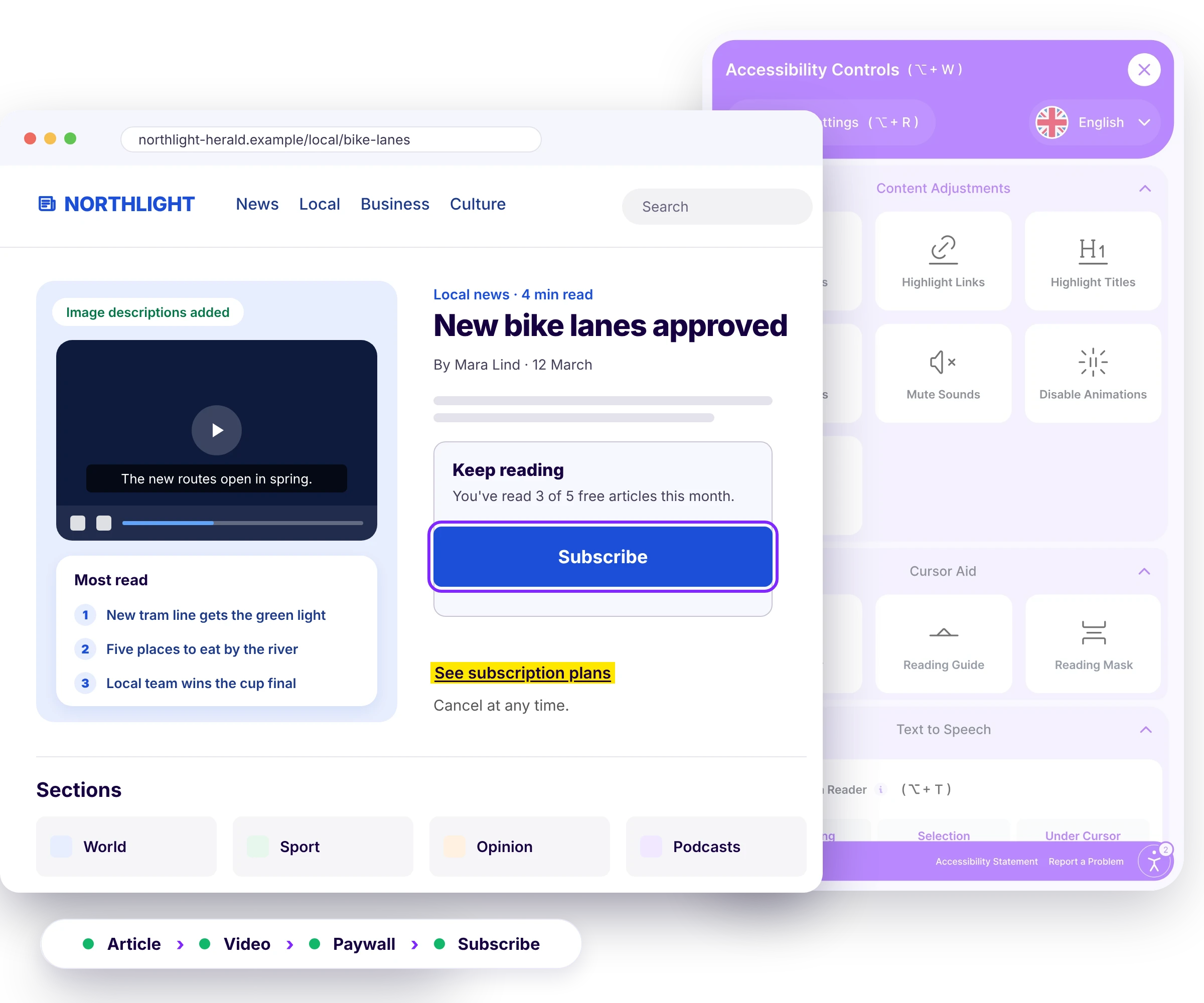
See the difference on an article with a paywall
Turn on a few widget settings and watch this sample article change. It's a small preview of what the Wawsome widget does on your site.
Try it on this article
City council approves new cycling routes
Local news. 4 minute read. Includes a 2 minute video.
You've read 3 of 5 free articles this month.
See subscription plansSubscribe
One platform. Every angle covered.
Automatic fixes
AI scans and patches selected issues such as missing image descriptions, broken ARIA and navigation structure.
Ongoing tracking
Your site is checked continuously, with accessibility score, issue trends and full history available in one place.
Easy setup
Deploy through one JS line or a GTM tag. Wawsome works at the browser layer, without server-side codebase changes.
Accessibility Statement
An individual Accessibility Statement, mapped in Wawsome documentation to the EAA, WCAG 2.1 AA, EN 301 549 and national laws.
Accessibility Widget
Predefined accessibility profiles, controls for text size, spacing, typeface, contrast and color scheme, keyboard-only navigation, screen-reader support, AI-assisted ALT and ARIA improvements, brand configuration and multi-language support.
Accessibility Scanner
WCAG 2.1 and 2.2 AA checks, prioritized plain-language reporting, Low, Medium and High severity, visibility across WCAG A, AA and AAA and an overall risk score.
- WCAG 2.1 and 2.2 AA
- EN 301 549
- European Accessibility Act


Continuous monitoring
Recurring scans check changes, alerts highlight areas that need attention and reports provide step-by-step remediation guidance.
A change goes live
A new article, an embed, a template change or a site release.
A recurring scan checks it
Wawsome scans your pages again on schedule.
An alert flags what changed
New issues are highlighted by severity.
The right team fixes it
Reports give step-by-step guidance.
Video players, subtitles and payment providers need their own plan
Many media journeys run through external video players, subscription platforms and payment providers. Wawsome works on your website and on vendor pages that allow the script. Wawsome doesn't produce subtitles or audio description. What it can't change in the browser goes into a clear plan for your team or vendor.
Needs the vendor or the source
- Subscription and login platforms run by a vendor, if the script can't be added there
- Payment pages hosted by a payment provider
- Video players and embeds from other providers
- Subtitles, audio description and transcripts for your video and audio
- Free or self-hosted widgets often need your own server or API, plus security updates you maintain
- No clear answer on where visitor data is processed, or a data processing agreement
What Wawsome does
- Runs on your website and on subscription pages that allow the script
- Monitors article, section, video and subscription templates from one place
- Reports third-party issues separately, for technical or contractual escalation
- Moves issues it can't fix in the browser into a prioritized technical backlog
- Hosted and updated by Wawsome, with no server or API to run on your side
- ISO 27001 certified information security and GDPR-aligned data processing
Accessibility that supports reach, engagement, subscriptions and publishing at scale.
Broader reach
More people can discover, navigate and consume your articles, video and audio.
- Organic traffic
- Pages per session
More engagement
Clearer navigation and easier content can support deeper reading across articles, sections and video.
- Engagement
- Return visits
Subscription support
Fewer barriers in login, paywall, registration and payment support a smoother path to subscribing.
- Subscription conversion
- Paywall completion
SEO support
Clear structure and good text alternatives help people and can help search engines understand your pages.
- Organic traffic
Brand credibility
Your commitment to inclusion is easier to believe when your own product is easy to use for people with disabilities.
- Subscriber retention
- Return visits
Publishing at scale
Continuous monitoring fits newsrooms where new content and template changes can bring issues back every day.
- Recurring issue rate
- Monitored coverage
Measure what accessibility changes
Accessibility work is easier to defend when you can see it in numbers. Wawsome tracks the accessibility side on every scan. Your teams can then follow the business KPIs that barriers affect most, journey by journey.
What Wawsome measures for you
Tracked on every scan, in one dashboard.
- Critical issues and overall risk score
- Recurring issue rate after releases and new content
- Time to fix, by severity
- Monitored coverage and template accessibility score
- Third-party issues, reported separately
Business KPIs accessibility can influence
KPIs that publishers and media teams already track. Watch them next to your accessibility data.
Audience and reach
- Organic traffic
- Pages per session
Engagement
- Time on site
- Return visits
Subscriptions
- Subscription conversion and paywall completion
- Subscriber retention
These are KPIs to watch, not promised results. The impact depends on your site, your journeys and how fast issues get fixed.
Trusted by Leaders and Industry Innovators


See where accessibility barriers may be limiting content consumption and subscriptions.
Start with your own media journey. Find barriers across templates, navigation, search, articles, video, login, paywalls and payment. Then build a prioritized plan to fix and monitor them.
Need a manual audit of your website and documents? See our audits
Digital accessibility is becoming part of how organizations measure inclusion, digital quality and customer experience.
The Valuable 500 includes digital accessibility among five proposed disability inclusion KPIs. It asks whether organizations review the accessibility of their digital platforms and content, and whether they have a plan to do so. Yet the research it cites shows most websites are still not fully accessible.
16%
of the world's population experience significant disability
Upwards of 90%
of the world's websites are not fully accessible to the disability community
Source: The Valuable 500
Journalism is written for everyone. Accessibility decides whether everyone can read it.
Media digital accessibility FAQ
What is digital accessibility for media websites?
It means making articles, navigation, search, video, login, paywalls, registration and payment usable for people with visual, hearing, motor, cognitive or other needs. It covers the whole journey, from finding a story to subscribing.
Why is accessibility important for publishers and media providers?
Media businesses depend on reach, attention and repeat visits. Barriers can stop part of your audience from finding, navigating or consuming content, and add friction to subscriptions.
Which media templates should be prioritized?
Start with reusable templates: article pages, the homepage, section pages, search, video, login and subscription steps. A fix there reaches many pages and journeys at once.
Does the European Accessibility Act apply to media services?
It depends on the service. The EAA covers services that give access to audiovisual media, like streaming sites, apps and players. News publishers aren't named, but online subscription sales to consumers can fall under its e-commerce rules. Subtitles and audio description fall under the Audiovisual Media Services Directive. Check your own services with your legal team.
How can accessibility affect subscription conversion?
Barriers in login, the paywall, registration or payment can stop an engaged reader from becoming a subscriber. That's why Wawsome treats these steps as commercial priorities. Measure the real effect on your own funnel data.
How can accessibility affect media engagement?
If navigation, article structure or player controls are hard to use, some visitors read fewer pages or spend less time with your content. Removing those barriers can support deeper reading and viewing.
How is accessibility connected to SEO for media websites?
Headings, semantic markup and text alternatives matter for accessibility and help search engines read your content. A 2025 Semrush study of 10,000 websites found that higher accessibility scores correlated with stronger organic traffic and keyword visibility. It's a correlation, not a ranking guarantee.
Why do media websites need continuous accessibility monitoring?
New articles, images, embeds, video and template changes go live every day and can bring new issues. Recurring scans find these regressions, so editorial, product and development teams work from the same baseline.
How should publishers handle accessibility in large archives?
Prioritize older pages and templates by traffic, value and risk, instead of trying to fix the whole archive at once.
What do the Wawsome Widget and Scanner do?
The Widget gives readers accessibility profiles and controls for text size, spacing, typography, contrast and color, plus keyboard-only navigation and screen-reader support. The Scanner runs WCAG 2.1 and 2.2 AA checks, ranks issues by severity and gives you a risk score, so teams can see what to fix first.
Can accessibility affect advertising revenue?
A hard reading or viewing experience can reduce time on site and pages read, which can put pressure on ad yield. Wawsome doesn't promise a revenue effect, so measure it against your own data.
Which media KPIs can accessibility influence?
Engagement, pages per session, organic traffic, return visits, subscription conversion, paywall completion and subscriber retention. Watch them next to your accessibility score and issue trend.
Does Wawsome require a complete website rebuild?
No. Wawsome deploys through a JavaScript tag or Google Tag Manager and works at the browser layer, without server-side codebase changes. Structural issues and third-party components that need source-level work are identified and prioritized separately.
Make accessibility part of how your content is published, read and monetized.
You already track engagement, subscription conversion, paywall completion, organic traffic, pages per session and subscriber retention. Add accessibility to the same measurement and find the barriers that may be limiting your reach or revenue.
- Accessibility Widget
- Scanner
- Continuous Monitoring
- Accessibility reporting
- JS or GTM setup
- Multi-language support